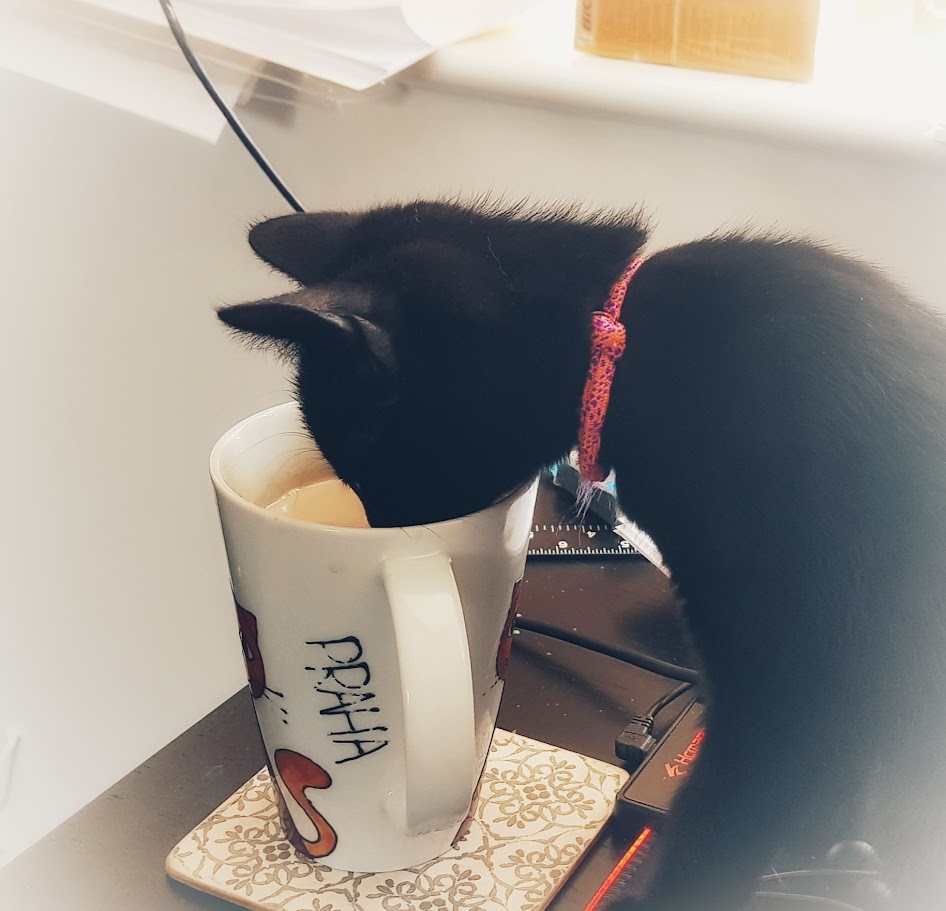
Formally speaking, my day ALWAYS starts with coffee. It does not matter if I want it or not. It comes on soft paws and, with a sudden “MIAW,” starts scratching at the door. My cat’s name is Kava, which means “coffee” in Ukrainian, and my little household ‘coffee’ is always hungry in the morning. And from my cat’s name, you may definitely say that I love coffee very much.
One day, I was making coffee and suddenly realized that the brass dzezva—a special pot for making coffee—is one of the few things I brought from home when I first came to the UK. And it reminds me of home each time I touch it.
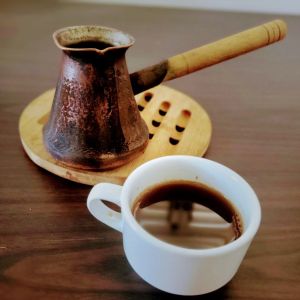
My parents always loved coffee. Black, strong, home-brewed. So do I, but with a little addition of milk and walnuts as a snack. Coffee was a ritual. Coffee meant everything stopped, and my mom or dad grabbed a coffee mill to make a fresh portion of ground coffee. Then it was a slow, meditative process of brewing it in a large brass dzezva to reach the perfect taste. And, finally, the process of drinking coffee with one or two cigarettes (my parents used to smoke at that time), with long philosophical talks or important life-related discussions. Coffee meant family time, relaxation, and a stop in the daily routine.
But it was not always as simple as that. Back in Soviet times, there were no coffee beans freely available to buy. We had a DIFITSIT (shortage) of almost everything. Coffee was no exception, same as tea, meat, sugar, winter boots, tomatoes, you name it. Some products, such as sugar, were even rationed when I was a child.
So how did we manage to get our cup of coffee in a time of total deficit? We had to go to the nearest Universam (the equivalent of a supermarket)—a 30-minute journey on public transport from my home. There was a cafeteria, and they made simple, plain coffee. We used to buy two portions and take them home in a thermos. And then, when the time came, the precious liquid was poured into cups and the ritual began.
My family is going through a tough time. My parents chose to stay in Kyiv, as they want to come to the UK as guests, not as refugees. My mother-in-law just passed away, and I was supporting her during her last month living at her home, far away from mine. But my mother-in-law had almost the same dzezva as I have in my Brighton home, and my parents have theirs in Kyiv. And I know that when there is a dzezva and a handful of coffee beans, I can manage.
 Korostenka